Showing posts with label regulations. Show all posts

Saturday, September 29, 2018

Weed Sells, But Who's Buying? California's Unregulated Market Takes Over


California is experiencing a significant decrease in revenue from medical cannabis sales than what state officials originally predicted.  Some cannabis industry analysts point to adult recreational use as the primary factor.  However, patients and providers will tell you that over-taxation and the added costs of testing, packaging and licensing fees have pushed patients to seek unregulated sources for their medical cannabis.

Cannabis retail providers will tell you that it’s not only patients that have stopped coming in, but local adults, that frequented dispensaries a year ago, also stopped coming in after the new taxes went into effect January 1, 2018. So, who’s buying from licensed and permitted cannabis shops in California?  Tourists.

This benefits cannabis retailers fortunate and/or foresight-full enough to secure a permitted location in a major tourist thoroughfare, such as the Haight-Ashbury or the Venice Boardwalk.  Boutique providers in lesser known communities report that they are having a tough time business-wise – daily visits are low, unregulated options are plentiful, and the cost of doing business is too expensive – unreasonably so.  

Many boutique cannabis business owners see California’s current regulatory system favoring large, wealthy corporations over smaller, local mom-and-pop businesses. Investment money is nearly mandatory these days to keep up and stay afloat.  However, this has always been the way of capitalism and big money and business regulations.  Big money gets what it wants from the rule makers.  The little guy gets hit the hardest.  The consumer ends up paying more in the end.  

Except most California cannabis consumers refuse to pay more and there are plenty of more affordable options outside of the licensed industry.  If smaller cannabis businesses in California want to survive, they are going to have to demand more affordable rules and lower taxation.  The price out of the door has to match or beat the price on the street and right now “black market is king” according to social commentary.   

The $35 affordable eighth to the $65 premium eighth has been the standard on and off the streets for many years.  If regulations can’t meet this consumer demand, then the consumer is going to get it at that price elsewhere.  Does the legislature realize that the excessive taxation and cost of regulation has caused the unregulated market or ‘black market’ to explode?  Do they already know and this is by design? Why?

Always follow the money.

Sunday, August 19, 2018

Getting To Know Patient Advocacy Network


Patient Advocacy Network has made a number of new friends recently that have questions about our work and in what direction we want to go.  Despite our long history in the medical cannabis movement, we know that there are many that are not familiar with our work.  We are excited to be engaging new friends.

PAN has relaunched the Compassion Flower Report as a show on Youtube.  President Degé Coutee did the Compassion Flower Report as a segment on the Hollywood Hemptress Hour with Tere Joyce, an online live radio show and podcast, until that show ended.  

In the inaugural episode of the relaunched show Degé talks about the history of the organization, the state of medical cannabis now and next steps.  The show will be posted by or before 4:20 p.m. PST on Fridays each week.

Compassion Flower Report - Inaugural Episode
https://youtu.be/JgDCNpi36sI

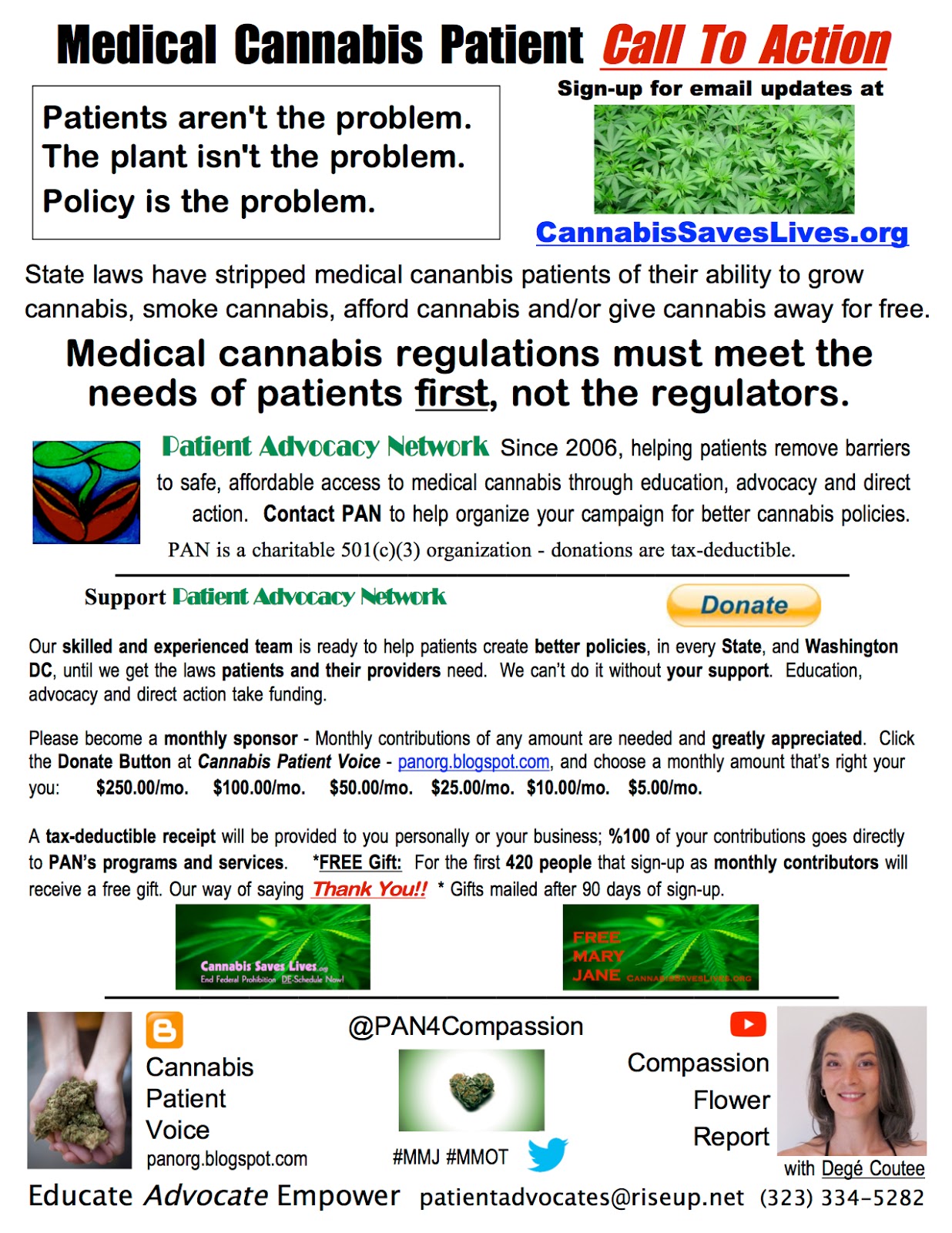
Some of PAN's new friends have asked for a flyer they can circulate among their colleagues.  We ask that you please share this flyer with your social networks.  There is a tremendous amount of work to be done to reform these detrimental policies. The more outreach and support helps us be more effective and move swiftly.  

Wednesday, August 15, 2018

Patients, Advocates And Providers Partner To Reform 64 For Fair, Affordable Regulations


Dear Colleague in Compassion,

I need your help to ensure that medical cannabis patients and providers have a voice in Sacramento. Over-taxation has made patient access to medical cannabis unaffordable for many.  Business operators report unworkable, burdensome, and expensive rules.  As a result of these issues there is a significant drop in the projected revenue California expected from the licensed cannabis industry.

Better regulations are needed now.  We cannot hesitate to take action.  Together, we can improve regulations, and protect patients and providers from excessive taxation and other barriers.  

Patient Advocacy Network is prepared to coordinate this effort, a collaboration of constituents and stakeholders engaging the legislature for fair regulations.  Please become a monthly sponsor now so PAN can get started immediately.

You will be invited to attend statewide task force meetings via conference call.  

You will receive informational and educational flyers to share with patients and caregivers.

Your contribution helps sponsor free letter writing workshops and other pertinent patient trainings.  

Your contribution will help sponsor patients’ travel to Sacramento to meet with legislative officials and deliver their letters.  We will also delivery letters on behalf of patients that are unable to travel. 

You will receive action alerts and be informed of any upcoming legislative hearings.

You will receive regular updates on the progress of the campaign.  


This effort takes diligence, consistency and commitment.  PAN is ready to start right now.  Your monthly donation ensures we move swiftly and consistently until we achieve our goal of fair regulations, and reasonable taxation for medical cannabis providers and patients.  

Donations are always tax-deductible and monthly contribution set-up is easy when you make your donation at Cannabis Patient Voice. 


Please choose a monthly sponsorship level that is best.

Medical Cannabis Provider Sponsorships
$100.00/mo. --  $150.00/mo.  --  $250.00/mo. -- Other


Patient Sponsorships
$5.00/mo. --  $10.00/mo.  --  $15.00/mo. 


Friends of PAN
$25.00/mo. --  $50.00/mo.  


Other payment methods and in-kind donations also accepted. A tax-deductible receipt will be provided.  PAN is a charitable 501(c)(3).  

If you have ANY questions, please contact me directly at (323) 334-5282.  I look forward to working with you.


Thank you for your support!


Sincerely,

Degé Coutee
President, Patient Advocacy Network

Patient Coach From SoCal

California Capitol 


Sunday, July 22, 2018

Some Of The Early Patient, Provider Survey Feedback


“The taxes are just too, damn high,” is the sentiment from most Californians and it’s now true for medical cannabis patients, too.  

PAN recently asked patients and providers how the new rules are affecting them.  Many patients reported no longer using retail outlets due to the cost and now use some other source, the un-regulated market.  

Shop owners are feeling this, too.  They report lower numbers of visits since the new taxes and fees took effect.   Some are frustrated with what they call rogue shops in their area, and state they know some of their patients have found growers to help supply them.  

Cultivators appear to be the most disgruntled with the licensing process, on both the local and state level.  In February of this year it was reported that only 0.78% of the estimated growers in California had been approved for a temporary license.  

The California Growers Association has filed a lawsuit against California Department of Food and Agriculture, the state agency that issues cultivation licenses.  The suit calls out new provisions in the regulations that allow a medium license holder to apply for an unlimited number of small cultivation licenses.  

The suit goes on to argue that Prop. 64 allowed a 5-year window for small growers to get established before the state issues what many refer to as the mega-licenses. This new policy of  “stacking” as the lawyers call it violates the intent of the voter initiative by basically creating a loophole to allow large-scale cultivation operations now.

California is not seeing the revenue it projected from the cannabis industry due to all of these issues.  

PAN continues take feedback, monitor the cannabis industry, work with the California legislature and help patients with Compassionate access.  

-----

Patient Advocacy Network is a charitable 501(c)(3) and needs your support.  

Please click the Donate button on this page and make a $25.00 donation.  You can also sign-up to be a monthly sponsor - $5 - $25 monthly donations go a long way!

All contributions directly benefit the programs and services of Patient Advocacy Network. A tax-deductible receipt will be provided.  

Thank you!

Friday, July 13, 2018

Patient And Provider Survey


Patient Advocacy Network wants to hear from patients about their experiences with accessing medical cannabis.  

Additionally, we want to here from medical cannabis businesses that are having a difficult time navigating and/or affording regulations, fees, and taxes.

PAN’s mission is to help patients get the safe, affordable access they need, and help providers get better regulations.  Your input helps us know where we need to focus our efforts.  Please let us know your experiences.  

You can leave your comments below, email us at patientadvocates@riseup.net or call us at (323) 334-5282.  We are here for patients and providers.  


Are your favorite dispensaries still around?

Have they survived regulations?

Are you able to find a location?  Do you live in a medical cannabis desert?

Can you afford medical cannabis?  Are all the new taxes and fees making such that you are going without, relying on the underground market?

Are you able to access Compassion Programs for free or discounted cannabis?

Has legalization in your state made it easier or harder to access affordable medical cannabis?


Were you able to get a business license or permit for your commercial cannabis business?

Are the taxes and fees pushing your business under?

Are you concerned that Big Agriculture, Big Pharma is going to leverage your state for a commercial cannabis takeover?

Have you decided that you have to operate underground?


We look forward to hearing from you.  We respect and honor your privacy in your responses.

Tuesday, November 03, 2015

Federal Interference In State Medical Marijuana Ends… But Only For Those That Can Comply


Medical marijuana dispensary operators in California, especially those still battling the federal government, are rejoicing over a recent federal court ruling.  United States District Judge Charles R. Breyer ordered a federal injunction against one of the state’s oldest dispensaries be lifted, ruling the recently enacted Rohrabacher-Farr Amendment prohibits the federal government from prosecuting dispensaries that are following state law.  However, just a few weeks ago, following state law in California meant interpreting the AG Guidelines as protocols for medical marijuana dispensary operations as the state had no definitive or legal regulations.  That has changed.

Then Attorney General Jerry Brown penned the guidelines in 2008, which dispensaries, collectives and cooperatives took as the only guidance from the state at the time, and while many cities still did not have local regulations in place.  These guidelines, while not law, stated that storefront dispensaries may be in less legal jeopardy if they operated as not for profit, received all cultivated cannabis from legally qualified patients and caregivers and the business operated as a closed-loop by and for patients. 

Come now the end of the 2015 California legislative session where the current Governor Jerry Brown has signed a set of regulatory bills (AB 266, AB 243 and SB 643) that have completely turned his guidelines upside down:  no requirement to be not for profit, no requirement to be a patient or caregiver in order to cultivate or manufacture, no requirement to be a patient or caregiver to dispense...  So, getting in compliance with state law is going to be a fete for those that built their operating procedures around the AG Guidelines.  These guidelines did not spell out how to be legal but how medical marijuana operations might be lawful. 

In order to be considered for a state dispensary permit, the operation has to have local approval.  One of the many ways in which collectives and cooperatives interpreted the guidelines was to cut out the storefront and operate as a patient-direct garden.  Those that were willing to talk about their operations to local officials were told, “if you’re not running a storefront business, then you are not required to get a permit.”  Patient-direct collectives and cooperatives became the invisible method for fulfilling Prop. 215, but now that statewide regulations are in place, these operations are in jeopardy, as no local permit exists for them. 

Likewise, the new medical marijuana laws have torn apart the closed loop by not allowing vertical integration. Collectives and cooperative that felt forced to keep close tabs on the cultivation and manufacture of their medical cannabis products will be limited on what other permits for which they can apply – forcing them to let go of some of their operations.  Dispensaries are not even allowed to go pick up their products under the new rules, but are forced to hire a licensed third party transporter.  So, again, getting in compliance with the new state laws is going to be a task for many and possibly financially devastating, but you better do it because this compliance is now the only thing standing between you and the feds – who are still wringing their hands for the opportunity to make an example of someone.

Related links:
Medical Marijuana Ruling Highlights Federal, State Discord


GUIDELINES FOR THE SECURITY AND NON-DIVERSION OF MARIJUANA GROWN FOR MEDICAL USE


Gov. Brown signs bill to regulate medical marijuana industry


*****

Patient Advocacy Network has provided compliance trainings, workshops and consultations for nearly 10 years and to well over a thousand dispensaries in California.  Contact PAN at (323) 334-5282 if you have any questions about compliance with local or state regulations.  We want to help as many Compassionate providers as possible continue to serve patients and thrive. 

Thursday, September 24, 2015

California Medical Marijuana Bills Await Governor's Signature, Industry Considers Next Steps

Willie Brown watches Gov. Jerry Brown sign a bill in 2011.

The 2015 California legislative session ended with three medical marijuana regulatory bills being passed through both houses in the last 6 hours of the session.  New statewide medical cannabis rules are expected to be signed by the Governor anytime.  These rules establish licensing guidelines for all commercial medical cannabis activities including cultivation and manufacture of concentrates. 

These rules are not without flaws or criticism.  The amended bills were kept under tight wrap until just before they were voted upon near midnight on the final day of the session.  The senate and assembly suspended the rules that allow for public input ensuring no one could provide feedback in the 11th hour.  There is also still legal debate on just how much these bills tread on Proposition 215, the 1996 voter-approved initiative known as the Compassionate Use Act. 

However, the rules are better than expected given previous versions and the direction other states have taken.  For example, New York does not allow flowers and Washington does not allow patients to grow their own, issues perpetuating a black or gray market in those states. 

Previous versions of California’s bills put medical marijuana under the purview of the Alcohol Beverage Control Board, a move harshly criticized by patients.  Consumer Affairs, Agriculture and Public Health are the departments that oversee commercial cannabis operations in California, which is far more appropriate.

PAN has received many calls from patients and providers wanting to learn how to comply with the new rules or how their businesses may be affected.  Here are some things to consider:

Getting a state license is contingent upon local approval.  In order to apply for state licensing, a cannabis business must have local approval.  Bans are still a huge issue.  Medical cannabis operations in communities with a ban are not allowed to apply for a state license and are in jeopardy of legal action. 

Everything you knew about the AG Guidelines is wrong.  The news bills have dismantled the AG Guidelines and parts of SB 420 by allowing commercial retail of medical marijuana and phasing out closed-loop, not-for-profit collectives and cooperatives.   

There are also many compliance dates in the bills.  The rules seem to acknowledge that not all aspects of the law can be fully functioning or implemented all at once.  Compliance will fold in as licenses become available through the newly formed Bureau of Medical Marijuana Regulation, such as for independent laboratory testing. (For example, the rules seem to recognize cannabis can’t be tested per the law until these approved testing sites exist.)

Patients can still grow their own; 100 sq. ft of total grow space.  Caregivers can grow for up to 5 other patients, 100 sq. ft of grow space for each patient.  No licensing is required as long as all activity is non-commercial.

The California legislature acknowledges these rules are not complete and have stated they will start working on amendments January 2016.  Likewise, voter initiatives to end bans, protect medical, as well as legalize cannabis for adult use are in motion.  While a set of rules will be on the books soon, those rules will probably change sooner than later.

There are numerous other functions of these laws to consider.  Any one with questions or concerns can contact PAN directly.

AB 266 text

AB 243 text

SB 643 text


Additionally, proponents of the statewide voter initiatives are making final amendments.  The drafting of the Marijuana Control, Legalization and Revenue Act of 2016, has always been an open-source process.  All are welcome to participate.  You are encouraged to review the most recent draft of the initiative and provide any feedback.  The initiative will be filed for a final title and summary in two weeks. 

MCLR text

Feedback on MCLR can be sent to:

or feel free to contact PAN with any questions.

Friday, September 11, 2015

Governor Brown, Don’t Let This Go Down


As we start this post, just after midnight, with less that 24 hours before the 2015 California legislative session ends, the state has not yet posted updated versions of the three medical marijuana regulatory bills: AB 243, AB 266 and SB 643.   In the finals days of the session, referred to as ‘Floor Session Only,’ the legislature gutted all three of these bills and re-referred them back to committee, naked.  

The other factor at play is that the Senate and Assembly have suspended some key rules.  One set of rules that is suspended allows the legislature to amend bills without posting the bill or allowing public input/comment.  The other set of suspended rules allows the legislature to call committees and hear bills despite this period being the ‘floor session only,” without public knowledge or input on the committee level.   This is what we are referring to when we state that the process has moved behind closed doors.

In the last couple hours the media has begun to post that a deal has been struck and the bills will be voted on today.  However, no one has yet to see them and it is anticipated they look very different that they did before they were gutted.   The Governor and the California Legislature have bypassed the democratic process while claiming to the media that the process has been transparent and everyone is at the table.  Not true!

Take Action!

1.) **Contact Governor Brown.
Phone: (916) 445-2841
Fax: (916) 558-3160
facebook: https://www.facebook.com/jerrybrown
Twitter:  @JerryBrownGov

Let him know: Governor Brown, Don’t Let This Go Down
No 11th hour, backdoor deals.  The public has the right to know what’s in these bills AND be allowed to provide input, feedback, comments.  Don’t thwart the democratic process! 


2.) ** Contact the bills’ authors with the same message.
Assemblymember Rob Bonta
Phone: (916) 319-2018
Fax: (916) 319-2118
facebook: https://www.facebook.com/Assemblymember-Rob-Bonta-160502927367568/timeline/
Twitter: @RobBonta

Senator Mike McGuire
Phone: (916) 651-4002
Fax: (916) 651-4902
Email: senator.mcguire@sen.ca.gov (despite this being his listed email, messages are bouncing - try this - http://sd02.senate.ca.gov/contact/email)
facebook: https://www.facebook.com/SupervisorMikeMcGuire
Twitter:@ilike_mike


3.) **  Also send a copy of what you forward to the Governor and the authors, to YOUR California Representatives.
You have one assembly member and one state senator.  Most of their contact information is on their individual websites. 

4.) ** Forward this information to everyone and post to all your social media all day today.


“Never doubt that a small group of thoughtful, committed, citizens can change the world. Indeed, it is the only thing that ever has.”  ― Margaret Mead


Concerns with previous versions of these bills:
*  Excessive taxes and fees - these regulations are to support the Compassionate Use Act not be a revenue stream for the state.  The CUA requires that medical cannabis be affordable. Some recent proposals would make medical cannabis so expensive the most vulnerable patients in the state would no longer be able to afford it - the people for whom Prop. 215 was originally intended. (The state will make money from legalization!)  But please, not off of the patients.

* Arbitrary dates that put one group of dispensaries in a different category that other just based on when they opened.  Many communities are still grappling with regulations and patients who have been working with their cities to operate legitimately should not be held to a different standard.

*  Special exemptions from accountability or transparency - previous versions of these bills would've allowed certain players to not have to acquire state certification and hence be exempt from any of those fees or accountability, clearly violating equal protection.

* Over-restrictive permitting - I have seen many regulatory attempts that are so cumbersome and expensive that it constitutes a de facto ban or supports a monopoly.

* No new criminal penalties!


#####

Wednesday, September 02, 2015

It's Complicated

Bill info at:  https://leginfo.legislature.ca.gov/faces/billTextClient.xhtml?bill_id=201520160AB243

Bill info at: https://leginfo.legislature.ca.gov/faces/billTextClient.xhtml?bill_id=201520160AB266

Bill info at:  https://leginfo.legislature.ca.gov/faces/billTextClient.xhtml?bill_id=201520160SB643

The current status of the California state legislature's medical marijuana bills is complicated.  The 2015 session is ending in a few days and the legislature doesn't seem any closer to crafting a workable set of guidelines for authentic medical cannabis providers.

Just days ago Governor Brown weighed in on language and now all of that language is gone.  All of it.  PAN watched as each bill was updated with the entirety of each bill redlined.  The only language left is the intent of the original motion.  (The links with each image above will take you to the complete file on that bill.)

Also complicated is each bill now mentions the other..."This measure shall become operative only if.." the other bills become operative.  Click on the Today's Law As Amended tabs to see how the legislature has made this very confusing.

We are unsure if these bills have become placeholders for the next session or if amended language will fill these empty bills in the 11th hour before a final vote this session.  The Legislature has suspended the rules that require them to give notice to or take comment from the public - Joint Rule 62(a).  Providing any input at this point is almost impossible.

In years past when the legislature has done this, it has meant the death of that bill.  However, in years past the bills were not completely gutted prior to a full vote, nor did they have the Governor's attention while still on the floor.  We do not understand this strategy but we intent to ask many questions in the next few hours to find out.

While PAN supports equitable guidelines and regulations for medical cannabis operations, these bills  are egregious (favoring collectives with high-paid lobbyists) and expensive (lots of new fees and taxes), hence violating Prop. 215.  The Legislature is treating medical cannabis like adult social marijuana, effectively taking the Compassion out of the Compassionate Use Act and making it the Use Act For Cash.

PAN isn't going to stand for that.

Tuesday, March 26, 2013

Sacramento Drafts Statewide Medical Cannabis Guidelines

 
State Assembly Member Tom Ammiano has ‘introduced’ AB 473 and while the bill appears in the legislative counsel’s digest at http://www.leginfo.ca.gov/pub/13-14/bill/asm/ab_0451-0500/ab_473_bill_20130219_introduced.html, the only statement regarding the intent of the bill is to “provide a comprehensive state regulatory structure for medical cannabis cultivation, processing, testing, and distribution.” 

The full text of the bill is not yet published but the media reported extensively last week that Ammiano’s proposed regulatory body for collectives is the Department of Alcohol Beverage Control (ABC). 

Ammiano Suggests Marijuana Industry Be Policed By Alcohol Board [Updated]

Medical Marijuana Patients Wary of Booze Cops Regulating Pot

The idea has sparked a variety of criticism.  Statewide guidelines seem like a sane prospect for collectives operating in areas where local regulations are non-existent, until one considers the jeopardy of placing every cultivator, hash maker, baker, trimmer… under a ‘comprehensive structure’ while federal prohibition is still in full affect.  Ammiano has urged that his legislation is needed in order to appease federal authorities citing Colorado’s statewide regulations.  However, Colorado continues to suffer federal interference and local bans despite a statewide program.  

Law enforcement officials around California are not keen on an alcohol – medical cannabis legal fusion.  Many patient advocates aren’t either, fearing the exposure of patients intimately involved with cannabis production, and additional fees and taxes that will put ma & pop collectives out of operation.  Others debate whether this is a step toward an adult recreation model and if that is a good or bad thing when considering this bill is supposed to be about Prop. 215, and not-for-profit patient collectives.  Some see this proposal as Ammiano’s attempt to generate significant revenue to fund a large enforcement bureaucracy off the backs of patients.  How much is a gram of cannabis going to cost when the cultivator pays a fee to grow, trimmer has to be licensed, mandatory testing fees, the dispensary is paying additional State fees and taxes? 

State Senator Mark Leno has hinted that he is working on a proposal as well.  Last year his bill was based on the State Attorney General Guidelines leaving enforcement to the municipalities.  Leno claims to be a patient advocate and concerned about affordable access to medical cannabis.  We shall see what/if he presents in this 2013 session.

Thursday, June 21, 2012

A Resolution By The People Of Los Angeles To Regulate Medical Cannabis


PAN has received numerous requests from our community to present Los Angeles City Council with a resolution to regulate medical cannabis collectives.  The following was submitted to the Council during their June 20, 2012 meeting.

*****

RESOLUTION


A Resolution before the City of Los Angeles by the People of Los Angeles in order to amend the Los Angeles Municipal Code to regulate medical cannabis business activities as to protect the rights of patients and the will of the voters.

WHEREAS, the voters of California approved Proposition 215, The Compassionate Use Act of 1996 (CUA) so that, with the recommendation of a physician, people with serious illnesses for which cannabis offers relief, can grow, obtain, transport and use cannabis without criminal jeopardy; and

WHEREAS, scientific medical research continues to demonstrate the therapeutic applications of cannabis for conditions such as Cancer, HIV/AIDS, Multiple Sclerosis, Post-traumatic Stress Disorder, Heart Disease and many other ailments; and

WHEREAS, cities such as West Hollywood, San Francisco, Palm Springs, Berkeley, Santa Cruz and others have successfully implemented workable, enforceable local guidelines for medical cannabis collective businesses sometimes called “Dispensaries;” and

WHEREAS, the People of Los Angeles support safe, legal access to medical cannabis for the nearly 400,000 qualified patients in the Greater Los Angeles area that utilize the over 800 patient collectives in the City; and

WHEREAS, the City of Los Angeles benefits from the local taxation it implemented on the Dispensaries yet has failed to create a workable, legal set of guidelines causing frustration among our law enforcement and our communities and prompting scores of lawsuits; and

WHEREAS, the City of Los Angeles has passed numerous motions since 2005, approving the implementation a local regulatory system and seating a Medical Marijuana Working Group for the purpose of drafting such guidelines and the Council's intent subsequently thwarted by the Los Angeles City Attorney's office with possible violations of State law; and

WHEREAS, the majority of the Dispensaries in the City of Los Angeles have self-regulated and been good neighbors by following The California State Attorney General Guidelines For The Security and Non-diversion of Marijuana Grown For Medical Use, August 2008, as well as creating jobs and revenue for Los Angeles and that many LA Dispensaries have grandfathering rights; and

WHEREAS, any ban on medical cannabis is a violation of the CUA, and the City of Los Angeles voted for a workable set of local medical cannabis guidelines and the People of Los Angeles support regulations that protect patients' rights, our communities and the will of the voters.


NOW, THEREFORE, THE PEOPLE OF LOS ANGELES DO RESOLVE AS FOLLOWS:

1.  The City of Los Angeles shall immediately:
            a.  Consult with outside counsel and any other related experts to draft a workable, enforceable set of local medical cannabis dispensary guidelines and look to other communities that have successfully implemented such for guidance;
            b.  Seat a citywide Medical Marijuana Taskforce made up of pertinent City staff and officials, medical cannabis patients and providers, and community and business leaders for the purpose of providing input on regulations and any future amendments, addressing concerns and creating any necessary subcommittees as needed;
            c.  Work with the California State Legislature and the U.S. Congress to realize a federal solution to the state-federal conflict regarding medical cannabis.

2.  Medical Cannabis Dispensaries in the City of Los Angeles shall:
            a.  Be any group of legally qualified patients and caregivers as defined by California State law that associate as a business entity for the purpose of legally dispensing medical cannabis exclusively amongst its registered members;
            b.  Be solely comprised of a private membership of legally qualified patients and their caregivers and obtain all of its medical cannabis products exclusively from its registered members;
            c.  Be good neighbors and operate within The California State Attorney General Guidelines For The Security and Non-diversion of Marijuana Grown For Medical Use, August 2008;
            d.  Follow reasonable security protocols by maintaining good lighting, appropriate signage, security cameras, safes, security guards or any security features deemed appropriate;
            e.  Be allowed fair permit hearings in their communities and be allowed to operate in accordance with the character and fashion of their neighborhoods and business communities.

I hereby certify that this Resolution by the People of Los Angeles was presented to the Los Angeles City Council at the Council meeting held on June 20, 2012.


Degé Coutee, Resident of Los Angeles
Medical Cannabis Patient and Social Justice Advocate

*****